
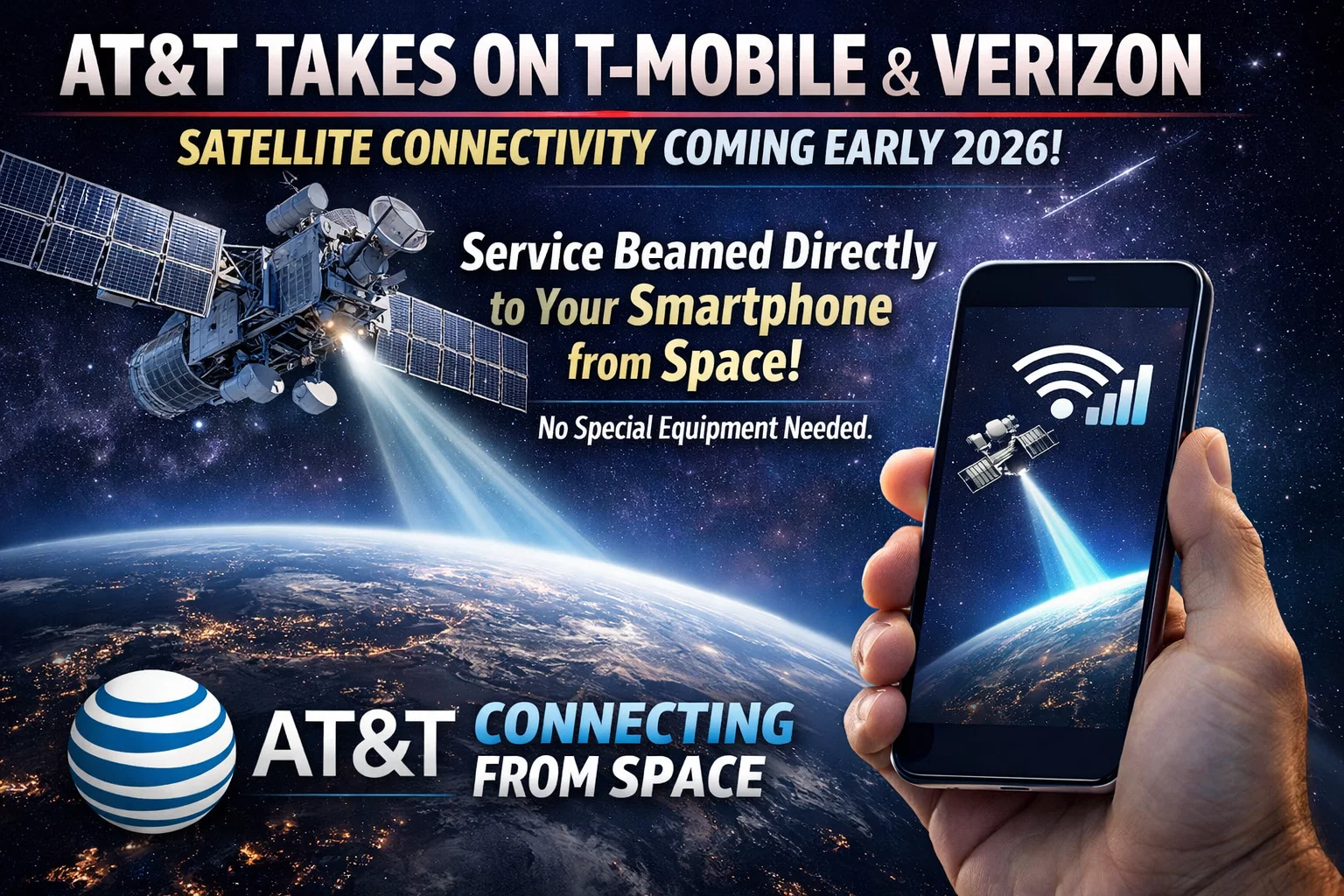
AT&T Secret Weapon to Crush T-Mobile in 2026: Satellites That Work Where Your Phone Doesn’t
AT&T drops a bombshell to start 2026. The telecom giant launches satellite service in the first half of this year—and it could change everything for customers stuck in dead zones. T-Mobile and Verizon better watch out.
Your phone struggles in remote areas. Camping trips turn into communication blackouts. Rural highways become no-service nightmares. AT&T’s new satellite service promises to fix that problem, connecting your existing smartphone directly to satellites orbiting above. No special equipment needed.
The Race to Space: AT&T Enters the Arena
AT&T partners with AST SpaceMobile to bring satellite connectivity to regular smartphones. The company successfully launched BlueBird 6, AST SpaceMobile’s first next-generation satellite, in December 2025. This satellite spans nearly 2,400 square feet—three times larger than previous BlueBird models.
The carrier plans a limited beta program for select customers and FirstNet users during the first half of 2026. Commercial launch follows after the beta program. AST SpaceMobile currently targets deploying four additional satellites by March 2026, building toward a robust constellation.
T-Mobile already launched its T-Satellite service in July 2025, partnering with SpaceX. Verizon joined the satellite game with its own AST SpaceMobile partnership. AT&T now fights to close the gap.
Why AT&T’s Satellites Beat the Competition
AST SpaceMobile’s satellites feature the largest active commercial antenna array in low Earth orbit. This massive size delivers three key advantages: better coverage, superior performance, and longer device battery life.
AT&T needs fewer satellites to match competitors. The company’s fourth ground gateway came online recently. These gateways bridge satellite traffic directly into AT&T’s core terrestrial network, positioned strategically across the country for maximum coverage and performance.
The technology works with devices you already own. No special satellite phones required. Your current smartphone connects seamlessly to satellite service when traditional cell towers fail.
First Responders Get Priority Access
Public safety agencies including the Texas Department of Public Safety, U.S. Customs and Border Protection, and Boulder County Sheriff’s Office tested the service in West Texas in December 2025. These agencies connected to the FirstNet network via AST SpaceMobile’s BlueBird satellites.
The tests included voice calls, data connections, and FirstNet Fusion—a mission-critical push-to-talk solution launching in 2026. Jared VandenHeuvel, director of Public Safety Solutions at Texas DPS, expressed confidence about the technology. Officers will patrol anywhere in Texas knowing they can stay connected during emergencies.
The FirstNet Authority invests in upgrading the dedicated FirstNet network core. This upgrade supports future satellite-to-device capabilities like priority and preemption on Band 14, plus mission-critical push-to-talk. These tools go beyond what commercial networks offer, extending FirstNet’s reach into remote and hard-to-reach locations.
The Technology That Makes It Possible
BlueBird 6 launched from the Satish Dhawan Space Centre in India on December 23, 2025. The satellite uses traditional cellular spectrum, allowing it to support already released cellular devices.
AT&T dedicates portions of its 850 MHz spectrum to the satellite service. When combined with AST SpaceMobile’s L-band spectrum holdings, the network delivers speeds up to 120 Mbps. That’s fast enough for video streaming, not just emergency texts.
The company accelerates its launch schedule. AST SpaceMobile targets one mission every one to two months, aiming for 45-60 satellites by the end of 2026. This constellation shift moves coverage from intermittent to continuous nationwide service.
Ground infrastructure matters just as much as satellites. AT&T’s fourth satellite gateway connects orbiting satellites to the company’s massive terrestrial fiber and wireless network. The carrier strategically places these gateways to optimize signal strength and reduce latency.
What Beta Users Can Expect
Select AT&T customers and FirstNet users gain early access in the first half of 2026. The beta program tests satellite service under real-world conditions before the commercial rollout.
Users should expect connectivity in places where traditional cell towers don’t reach. Remote hiking trails, vast farmland, offshore locations, and mountainous terrain all become connected zones. The service works indoors and in areas without clear sky views, though performance varies.
AT&T focuses the initial rollout on the continental United States. However, AST SpaceMobile signed agreements with more than 50 mobile operators worldwide, setting the stage for future international expansion.
The Competitive Battlefield Heats Up
T-Mobile beta tested its SpaceX-powered satellite texting service throughout 2024, launching commercially in July 2025. The carrier prices its service up to $20 monthly for AT&T and Verizon customers. T-Mobile’s service currently covers 500,000 square miles using 650 Starlink satellites.
T-Mobile’s satellites enable text messaging, picture messages, and voice messages on select Android devices. Future plans include video calling capabilities. The carrier positions satellite connectivity as a competitive advantage, though adoption remains limited so far.
Verizon launched free satellite messaging through Skylo in March 2025, compatible with select Android phones only. The carrier also partnered with AST SpaceMobile, planning to leverage 850 MHz low-band spectrum for future expanded services.
AT&T bets on superior satellite technology and FirstNet integration. The company’s larger satellite antennas require fewer units in orbit while delivering better performance. This efficiency could translate to lower costs and better service quality long-term.
Business Impact and Future Growth
Satellite service represents a strategic coverage gap solution, not an immediate revenue driver. AT&T’s 2026 financial guidance doesn’t expect material impact from satellite operations during the beta phase.
The real growth story centers on AT&T’s massive fiber buildout, targeting 50 million locations by 2030. The company projects $18 billion+ in free cash flow for 2026, providing financial flexibility to support satellite initiatives alongside fiber and 5G expansion.
Satellite service tackles AT&T’s most challenging coverage problem—remote and rural areas where traditional infrastructure proves economically unviable. These locations represent the last frontier for true nationwide coverage.
The company faces execution risks. AST SpaceMobile encounters launch supply bottlenecks and must accelerate from a slow start. The satellite provider has only six BlueBirds in orbit currently and must launch five more by the end of Q1 2026, then maintain a pace of one mission every one to two months.
Multiple launch providers help spread risk. SpaceX handles some missions, while Blue Origin’s upcoming New Glenn rocket adds capacity—though its flight availability remains uncertain. Satellites 8 through 25 sit in various assembly and testing stages, creating potential chokepoints that could delay the entire rollout.
What This Means for You
Your smartphone gains coverage in places it never worked before. Camping trips no longer mean total communication blackouts. Road trips through rural America maintain connectivity. Emergency situations in remote locations become less dangerous.
The service doesn’t require expensive satellite phones or special equipment. Your current device works with AT&T’s satellite network when traditional towers fail. This seamless integration represents the technology’s killer feature.
Battery life improves compared to alternative satellite solutions. The large antenna arrays on AST SpaceMobile satellites reduce power requirements for your device to maintain connections. Your phone doesn’t work as hard to reach orbit.
Voice calls, text messages, and data connections all function via satellite. This beats basic SOS messaging offered by some competitors. You maintain fuller communication capabilities even in the most remote locations.
FAQ: Everything You Need to Know About AT&T’s Satellite Service
When will AT&T satellite service be available to regular customers?
AT&T launches a limited beta program for satellite service in the first half of 2026, giving select customers and FirstNet users early access. The company plans to follow the beta with a broader commercial launch later in 2026. AST SpaceMobile aims to deploy 45-60 satellites by the end of 2026, which would enable continuous nationwide coverage. The exact commercial launch date depends on successful beta testing and satellite deployment schedules. If you’re not selected for the beta program, you’ll likely wait until late 2026 or early 2027 for full public access.
Do I need a special phone or equipment for AT&T’s satellite service?
No special equipment or satellite phones required. AT&T’s satellite service works with your existing smartphone. The service uses traditional cellular spectrum that already released devices support. Your current phone connects seamlessly to AST SpaceMobile satellites when you’re outside traditional cell tower range. This differs from standalone satellite communicators that require separate devices. The technology leverages your phone’s existing cellular radio—no hardware upgrades, no special antennas, no modifications needed. You simply gain coverage in places where AT&T towers don’t reach.
How fast is AT&T satellite internet compared to regular cell service?
AT&T’s satellite service delivers speeds up to 120 Mbps when combining the carrier’s 850 MHz spectrum with AST SpaceMobile’s L-band holdings. That’s fast enough for video streaming, not just basic texting or emergency calls. Traditional AT&T 5G offers faster speeds in urban areas with strong signals, but satellite connectivity shines in remote locations with zero conventional coverage. The service provides voice calls, text messages, and data connections from orbit. Battery life also improves because AST SpaceMobile’s large antenna arrays reduce power requirements for your device to maintain satellite connections.
Will AT&T satellite service work everywhere in the United States?
AT&T focuses the initial satellite service rollout on the continental United States. The service provides coverage in remote areas, rural highways, mountainous terrain, and offshore locations where traditional cell towers don’t reach. It works indoors and in areas without perfect sky views, though performance varies by location. AST SpaceMobile plans to deploy 45-60 satellites by the end of 2026, enabling continuous coverage rather than intermittent service. The company signed agreements with over 50 mobile operators worldwide, suggesting future international expansion. For now, expect domestic coverage with some limitations during the beta phase.