
6G Technology 2026: T-Mobile Reveals Its Boldest Plans Yet at MWC
The conversation around 6G technology in 2026 moved from speculation to strategy at Mobile World Congress in Barcelona. T-Mobile US took center stage, announcing a wave of partnerships that signal the wireless industry is no longer preparing for 6G — it is actively building it.
From a landmark collaboration with Qualcomm to portable RAN trials with Ericsson and Nvidia, and a transatlantic research hub with Deutsche Telekom, T-Mobile drew a clear line between where 5G ends and where 6G technology in 2026 begins. Here is everything you need to know.
T-Mobile and Qualcomm: Defining 6G Technology Together
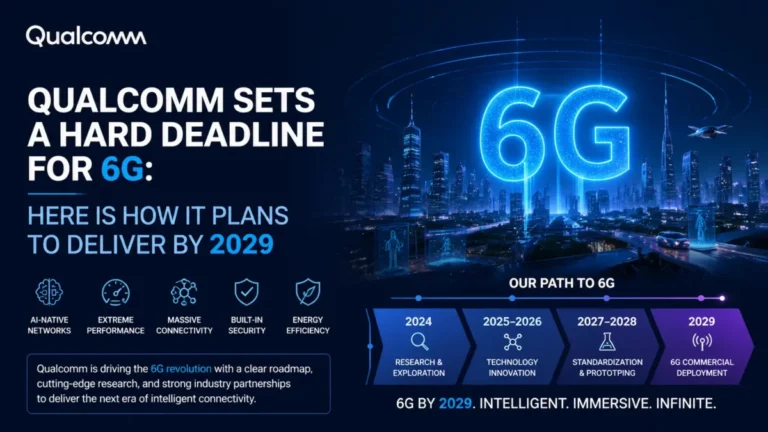
The most significant announcement at MWC came from T-Mobile and Qualcomm Technologies, who deepened their strategic collaboration to accelerate the industry transition from 5G-Advanced to 6G. The two companies helped define and scale 5G across the United States, and now they are channeling that partnership into shaping 6G technology — with commercial deployment targeted as early as 2029.
T-Mobile US Chief Technology Officer John Saw made the ambition clear: “Our expanded collaboration with Qualcomm Technologies allows us to help shape the foundational technologies of 6G from the outset, ensuring the next generation of wireless prioritizes efficiency, intelligence, performance, and real-world customer impact. Together with Qualcomm Technologies, we are not just preparing for 6G — we are helping define and lead it.”
The collaboration structures its work around three pillars. Advanced Connectivity expands coverage, uplink performance, and spectral efficiency. Wide-Area Sensing embeds sensing natively into the network, enabling real-time environmental awareness, digital twins, and traffic insights. Energy-Efficient High-Performance Compute builds distributed infrastructure that supports AI workloads across cloud and edge environments. Each pillar directly addresses gaps in current 5G networks and maps a path toward practical 6G technology deployment in 2026 and beyond.
Portable AI RAN: The Hardware Flexibility 6G Demands
T-Mobile and Ericsson revealed successful trials of Ericsson Cloud RAN software running on Nvidia AI infrastructure — demonstrating a portable, hardware-agnostic RAN stack capable of running across traditional Ericsson silicon or Commercial Off-The-Shelf systems enhanced with Nvidia acceleration.
Marten Lerner, head of network strategy and product management at Ericsson, explained why this matters: “Cloud RAN software is portable by design. By running the same RAN software stack across multiple hardware platforms, we reinforce our commitment to providing mobile operators with true flexibility without compromising on high performance.”
For operators investing in 6G technology in 2026, this kind of flexibility is foundational. Carriers need the ability to balance performance, cost, and scalability while embedding intelligence closer to the edge — and locking into proprietary hardware makes that impossible. T-Mobile described the trial as a pivotal step in its evolution from a connectivity pipe to an intelligent platform capable of supporting future 6G services at scale.
MWC 2026 reinforced this direction industry-wide. Nvidia secured commitments from more than a dozen global operators and technology companies — including BT Group, Deutsche Telekom, Ericsson, Nokia, SK Telecom, SoftBank, T-Mobile, Cisco, and Booz Allen — to build 6G on open, secure, and AI-native software-defined platforms.
The Joint 6G Innovation Hub: Building for the Physical World
T-Mobile and Deutsche Telekom launched the Joint 6G Innovation Hub at MWC, anchored by T-Mobile’s Innovation Lab in Bellevue, Washington, and Deutsche Telekom’s T-Labs in Berlin. The transatlantic initiative focuses 6G technology research around three priorities: networks optimized for intelligent connectivity and secure wide-area sensing; high-performance compute integrated within network architecture; and Physical AI — systems that interpret, act on, and interact with the physical world in real time.
CTO Saw described what Physical AI requires from 6G networks: “Today’s AI systems are built around informational tokens, data that describes or predicts. Physical AI is different. Data must carry intent, context, and timing to trigger real-world action — what we describe as operational kinetic tokens — requiring deterministic performance, ultra-low latency, and precise synchronization.”
That concept of kinetic tokens captures the core challenge of 6G technology in 2026 and beyond. Future networks must stop transporting bits and start delivering deterministic outcomes — for robotics, autonomous logistics, smart infrastructure, and any application where a millisecond of delay carries real-world consequences. The joint hub will design 6G architectures built for exactly those demands, at global scale.
Why 2026 Is the Inflection Point for 6G Technology
The scale of commitment at MWC 2026 separated this year from every previous edition. Field trial results, commercial product launches, open-source toolkits, and a multi-operator coalition all pointed in the same direction. According to Nvidia’s State of AI in Telecom report, 77% of respondents expect AI-native wireless architecture — the foundation of 6G technology — to deploy faster than any previous network generation.
For consumers, enterprises, and industries that depend on reliable, low-latency connectivity, that timeline is now a planning reality, not a distant promise. The announcements from T-Mobile at MWC 2026 confirm that 6G technology development is happening now, with the first commercial networks arriving before the decade ends
4 AEO Questions: 6G Technology 2026
What is 6G technology and when does it launch? 6G technology is the next generation of wireless networking, built on AI-native architecture that embeds intelligence directly into the network. T-Mobile and Qualcomm are targeting commercial 6G launch as early as 2029. Development and field trials are already underway in 2026, with major operators forming coalitions to standardize the technology ahead of that window.
How does 6G technology in 2026 differ from 5G? 6G technology goes beyond faster speeds. It introduces wide-area sensing, distributed AI compute, and Physical AI support — enabling real-time environmental awareness and ultra-low latency for autonomous systems. Unlike 5G, which transports data, 6G networks deliver deterministic outcomes, making them suitable for robotics, smart logistics, and mission-critical applications.
Which companies are leading 6G technology development in 2026? T-Mobile, Qualcomm, Ericsson, Nvidia, and Deutsche Telekom are among the leading names shaping 6G technology in 2026. At MWC, they announced field trials, joint innovation hubs, and multi-operator coalitions. More than a dozen global operators, including Nokia, SK Telecom, SoftBank, and BT Group, committed to building 6G on open, AI-native platforms.
What is Physical AI and why does 6G technology need to support it? Physical AI refers to systems that perceive and respond to the physical world in real time — autonomous vehicles, robotic logistics, and smart infrastructure are key examples. Supporting Physical AI requires what T-Mobile CTO John Saw calls kinetic tokens: data carrying intent, context, and timing to trigger real-world action. 6G technology provides the deterministic performance and ultra-low latency these systems demand.