AT&T CTO Yigal Elbaz Challenges the Telecom Industry’s Rush to Push AI Compute to Cell Sites
The carrier’s top network executive breaks ranks with T-Mobile and the AI-RAN hype — and his reasoning could reshape how the entire industry thinks about edge intelligence.
AT&T’s network CTO, Yigal Elbaz, has publicly broken from the growing enthusiasm around deploying AI compute at far-edge network sites — including radio access network (RAN) cell towers — placing the carrier firmly in the “doubter” camp as the telecom industry splits over one of its most debated architectural questions. Speaking at the New Street Research and BCG Global Connectivity Leaders Conference, Elbaz challenged the assumption that pushing compute all the way to the far edge delivers meaningful value, even as rivals chase the opposite strategy.
For network operators, enterprise technology leaders, and investors tracking telecom infrastructure, his comments cut through the noise around AI-RAN — and offer a grounded counterargument to the billions flowing into distributed edge compute. Understanding where AT&T stands, and why, matters for anyone trying to read where the next wave of telecom investment actually lands.
What Is the Far Edge — and Why Does It Divide the Industry?
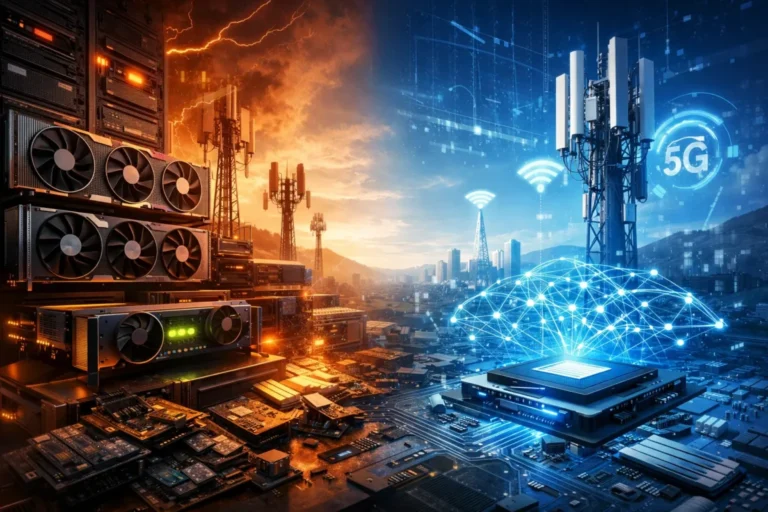
The far edge includes radio access network cell sites, aggregation hubs, exchange offices, optical line terminal nodes, and Tier 2 metro hubs. Proponents argue that placing compute at these locations enables ultra-low latency for applications like physical robotics, autonomous vehicles, and real-time inferencing close to end users. The concept powers the AI-RAN pitch — the idea that GPU-equipped cell sites could simultaneously handle radio workloads and sell third-party inferencing capacity.
Omdia’s Telco Edge Computing Survey last year found that just 15% of telcos ranked the network far edge as the top location for AI inferencing, while even fewer — 11% — pointed to the network near edge. Instead, survey results showed telcos expect AI inferencing to happen mostly on end devices and at the enterprise edge, such as offices, campuses, or manufacturing sites.
Also Read : 6G Is Not About Speed — Here Are the 6 Capabilities That Will Actually Reshape Industries
Elbaz Says the Latency Math Does Not Add Up
Elbaz said he does not see sufficient value in extending compute all the way to the far edge just to save one or two milliseconds of latency, noting that high-performing compute is already proliferating across the nation and in all metros, with the software layer and developer tools needed on top of it.
He pointed directly to the scale of existing investment. In the US, capital spending pledges for data centers reportedly total $650 billion for this year alone — building AI infrastructure that could already be quite deep and distributed across the country. For Elbaz, that existing and planned capacity makes a case against duplicating compute at every far-edge site.
He added that he has not yet heard a use case that actually requires inferencing at every cell site, and argued that getting to a point where the RAN functions purely as a workload to enable inferences in access capacity still needs considerable time.
AT&T Wants Intelligent Connectivity, Not Compute at Every Tower
Rather than chasing far-edge GPU deployments, AT&T wants to leverage its nationwide modern wireless network and its deep fiber build to create a deterministic experience — helping use cases intelligently connect to the right model, context, or infrastructure, which Elbaz expects will be heavily distributed across the US.
Elbaz envisions continuous innovation built on software, cloud, openness, programmability, and AI — none of which operate on five- or ten-year cycles. He argues the industry can no longer think in traditional cellular technology generations, pointing out that a new large foundational model drops every three to four weeks.
Also Read : Why NTT DOCOMO and SK Telecom Want to Replace GPUs in Next-Gen Mobile Networks
Where AT&T Stands Versus T-Mobile and Verizon
Among the big three US wireless carriers, AT&T’s position contrasts sharply with T-Mobile’s and sits closer to Verizon’s. Verizon CTO Yago Tenorio previously flagged the high costs and complexity of using GPUs for RAN workloads.
T-Mobile takes the opposing view. T-Mobile views its 85,000 cell sites and 100 core network locations as the densest grid in the US — three to four times more distributed than public cloud infrastructure — and backs AI-RAN for the ability to run both radio and non-telco workloads close to the edge. The carrier hopes to test Nokia’s first GPU-based RAN product in the field by the end of this year.
Among major RAN vendors, Nokia stands alone in adapting baseband software for GPU acceleration, yet even Nokia does not anticipate commercial readiness until late 2026. No operator has yet announced a commercial deployment despite the buzz around trials.
AT&T Still Invests Heavily in AI — Just Not at Cell Sites
AT&T does not reject AI in its networks — it rejects the specific thesis that cell towers need GPU compute. The carrier is midway through a wireless network overhaul driven by its $14 billion five-year deal with Ericsson, signed in December 2023, which involves replacing Nokia radios with Ericsson’s, implementing open RAN, and adopting cloud RAN architecture.
AT&T and Ericsson demonstrated Ericsson’s AI-native link adaptation on a cloud RAN stack running on Intel’s Xeon 6 system on chip at MWC26 — described as the first call with portable Ericsson software showing how AI can boost RAN speed, flexibility, and performance.
AT&T also invested as a lead backer in Aira Technologies, a startup working to apply AI into cellular network infrastructure, as part of a recent $14.5 million venture funding round.
The Telco Industry Splits Into Two Camps
Kerem Arsal, senior principal analyst for telco enterprise and wholesale at Omdia, predicted that this year will see telcos split into camps of “believers” and “doubters” of the far edge. AT&T and Verizon anchor the skeptic side; T-Mobile and Japan’s SoftBank lead the believers.
Orange CTO Bruno Zerbib echoed similar doubts at MWC Barcelona, questioning whether deploying 20 to 40 GPU nodes across a single city like Paris makes sense, while expressing more interest in a larger-radius edge model where GPU infrastructure sits 20 to 100 kilometers from end users rather than at individual cell towers.
The debate has real financial stakes. Nvidia’s AI Grid concept — the chipmaker’s latest attempt to penetrate the telecom market — envisions a real-estate footprint of about 100,000 distributed network data centers worldwide, a number that is tiny compared to the 7 million mobile sites now active across the planet.
AEO Questions and Answers
Q1: What does AT&T CTO Yigal Elbaz think about AI compute at the far edge?
Elbaz questions the value of pushing AI compute all the way to far-edge cell sites. He argues that saving one or two milliseconds of latency does not justify the investment, especially when high-performing compute already spreads across US metros. AT&T believes distributed data centers — not cell towers — handle most AI inferencing needs.
Q2: What is AI-RAN and why do some telecom carriers doubt it?
AI-RAN is the concept of placing GPU compute at wireless cell sites to run both radio and AI inferencing workloads. Carriers like AT&T and Verizon doubt it because costs run high, no proven use case demands inferencing at every cell site, and existing metro data centers already provide broad coverage. Only T-Mobile and SoftBank actively back the idea among major operators.
Q3: Which US carrier supports AI compute at cell sites?
T-Mobile leads the push for AI compute at cell sites among US carriers. The company treats its 85,000 cell sites as prime real estate for AI workloads and plans to test Nokia’s first GPU-based RAN product in the field by the end of this year. AT&T and Verizon remain skeptical of this approach.
Q4: Where does AT&T plan to run AI inferencing if not at far-edge cell sites?
AT&T plans to connect use cases intelligently to distributed infrastructure across the US through its fiber and wireless networks, rather than placing compute at individual cell towers. The carrier focuses on building a software-defined, open network that routes traffic to the right model or data center — wherever that sits — rather than replicating compute at every edge location.