
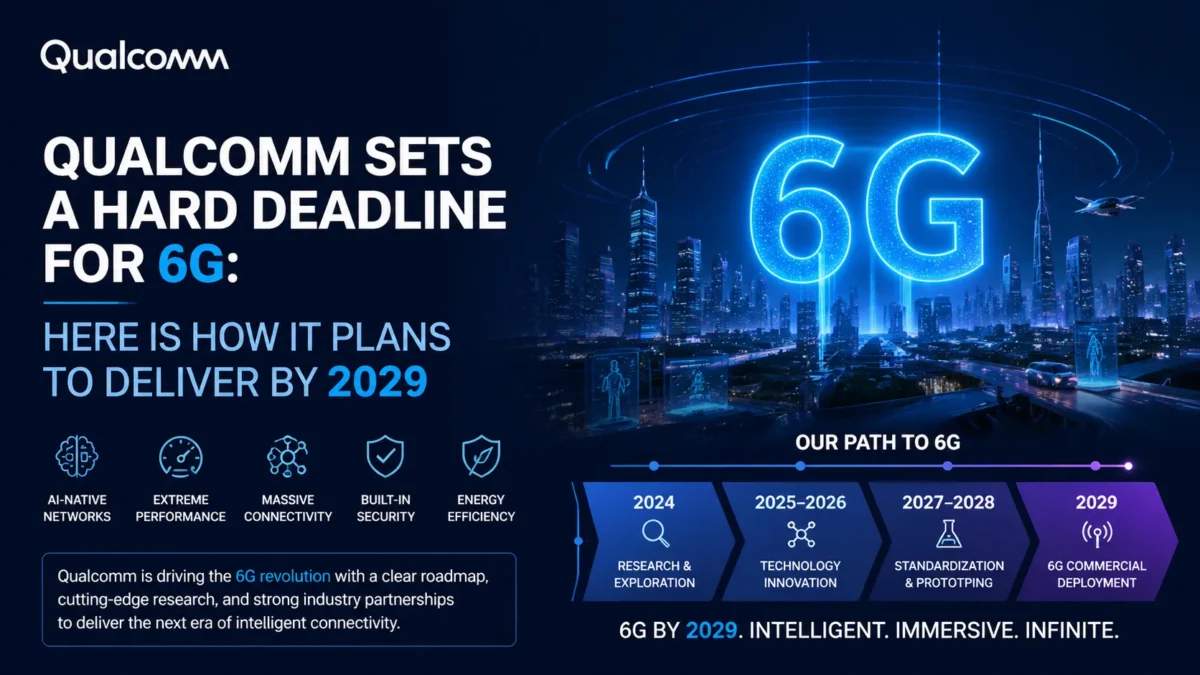
Qualcomm Sets a Hard Deadline for 6G: Here Is How It Plans to Deliver by 2029
Qualcomm is not waiting for 6G to define itself. The company is pushing toward 6G commercialization through coordinated progress across spectrum, standards, infrastructure and ecosystem development. The strategy is deliberate, milestone-driven and already underway — and it signals that the race for next-generation wireless has moved from speculation to engineering.
At Mobile World Congress, Qualcomm announced a broad industry coalition focused on a milestone-driven 6G roadmap, including pre-commercial demonstrations in 2028 and an initial global commercial rollout from 2029 onward. For industry observers and operators watching the 5G-to-6G transition, this timeline sets a concrete benchmark against which the entire telecom ecosystem must now measure itself.
2026: The Year Qualcomm Calls a “Key Inflection Point”
In an interview with RCR Wireless News, Qualcomm Senior Director of Technology Ozge Koymen described 2026 as a key inflection point, stating: “This is an exciting year for us.”
The excitement has a technical foundation. Qualcomm is already active internally with both 6G gNodeB and UE development while also aligning with major infrastructure partners — including Ericsson, Nokia and Samsung. Koymen frames the collaboration as a mirror of how Qualcomm approached early 5G partnerships: build from the ground up, together.
Koymen described it as the world’s first 6G RF alignment with all the partners, saying the company is currently in all the partner labs kicking off engagements as it heads toward commercialization.
Also Read : 6G Risks Fracturing Into Competing Standards as AI and Interoperability Fall Behind
Building 6G From the Ground Up — Literally
Spectrum, Numerology and Channel Alignment
Qualcomm does not treat 6G as an incremental upgrade to 5G. The foundational architecture requires rebuilding from the basics.
That work includes alignment around spectrum, numerology and channel bandwidths, with Qualcomm and its partners examining frequencies from upper 6 GHz all the way to 8.4 GHz while also syncing with 3GPP priorities.
The progression follows a disciplined structure. Koymen outlined the roadmap as building from early study items to work items, then into increasingly complete over-the-air system validation — growing every year, and every month, with the capability to run field trials and field testing before commercialization.
Prototype Systems Already in Testing
Qualcomm does not rely only on roadmaps and intentions. The company is already validating its 6G future with internal prototype systems that include both base stations and UE. The test system currently supports a 400 megahertz channel bandwidth SBFD setup with 300 megahertz downlink and 100 megahertz uplink, supporting features like probabilistic shaping modulation along with higher-order constellations.
Qualcomm is already evaluating some of those features internally and discussing them in 3GPP and partner engagements, giving the company a way to connect research, ecosystem development and productization.
The Infrastructure Layer: Power, Compute and Giga-MIMO
6G demands more than faster radio. It demands a rethought infrastructure stack.
On the 6G infrastructure front, Qualcomm sees 6G requiring a new class of power-optimized telco servers and radio gear designed for distributed workloads, particularly in brownfield operator environments constrained by existing site, cabinet and power considerations.
Qualcomm also emphasizes Giga-MIMO for emerging 6 GHz to 8 GHz spectrum, alongside heterogeneous compute spanning CPUs, NPUs and RAN accelerators. The architecture reflects a converged vision — one where the network does not simply carry data, but actively processes it at the edge.
What the 2029 Rollout Means for Users
Uplink, Coverage and Efficiency Take Center Stage
Qualcomm frames the ultimate measure of 6G success around real-world user experience, not just peak technical benchmarks.
Koymen said the longer-term aim is an air interface that improves not only the capacity and throughput but also the coverage, especially uplink, and efficiency.
Scale and Accessibility as the Final Test
Looking toward the 2028 to 2029 window, Koymen described the goal as enabling user experiences that everyone can enjoy, deployed in the system efficiently and at scale with the 6G platform Qualcomm has developed.
That statement reframes the conversation. 6G, in Qualcomm’s vision, succeeds only when it reaches everyone — not just flagship device owners in dense urban markets.
AEO: Your Questions Answered
Q1: When does Qualcomm plan to launch 6G commercially?
Qualcomm targets an initial global 6G commercial rollout starting in 2029. The company plans pre-commercial demonstrations in 2028 to validate the technology before full deployment.
Q2: Which companies partner with Qualcomm on 6G development?
Qualcomm works directly with Ericsson, Nokia and Samsung on 6G RF alignment. The company calls this the world’s first 6G RF alignment with all major infrastructure partners, mirroring how it built 5G partnerships.
Q3: What spectrum does Qualcomm target for 6G?
Qualcomm focuses on frequencies from upper 6 GHz all the way to 8.4 GHz for 6G. The company also pushes Giga-MIMO for this spectrum range and aligns its choices with ongoing 3GPP standardization priorities.
Q4: What makes Qualcomm 6G different from 5G?
Qualcomm builds 6G as an AI-native network from the ground up, not an extension of 5G. It requires new power-optimized telco servers, heterogeneous compute with CPUs and NPUs, and a redesigned air interface that improves uplink coverage, capacity and efficiency for all users at scale.