The telecommunications landscape stands at a critical turning point. Data traffic explodes as artificial intelligence, quantum computing, and the Internet of Things demand unprecedented bandwidth. Networks must evolve faster than ever before to keep pace.
Telecom Industry Revolution: 6 Game-Changing Trends

Table of Contents
You’ll discover how telecom infrastructure transforms from passive data pipes into intelligent, self-aware systems. These emerging trends will determine which industry leaders thrive and which fall behind in the race for next-generation connectivity.
AI Agents Transform Network Management
Agentic AI represents a quantum leap beyond simple chatbots. These sophisticated systems execute complex, multi-step tasks with minimal human oversight. Networks gain the ability to detect problems, fix issues in real-time, and optimize performance automatically.
Ericsson develops autonomous applications that spot anomalies in radio access networks instantly. The self-healing capability reduces downtime and slashes operational costs. Industry analysts project the agentic AI market in telecommunications will surge from $3.75 billion to nearly $12 billion by 2030.
Companies deploy AI agents across customer service platforms, eliminating wait times and resolving issues before users notice problems. Verizon’s partnership with Google Cloud demonstrates this power—their AI assistant delivers a 40% increase in sales team effectiveness while handling billing, upgrades, and account management seamlessly.
6G Networks Take Shape
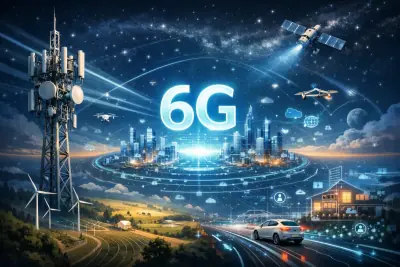
Commercial 6G services won’t arrive until 2030, but 2026 marks a decisive year for development. Engineers hammer out technical specifications while operators secure strategic positions in the next connectivity revolution.
Terahertz spectrum research accelerates rapidly. This frequency range operates between 300 GHz and 3 THz, offering unprecedented throughput rates and spectrum efficiency. Telecom leaders prioritize this research to avoid repeating 5G monetization mistakes.
The new standard promises more than raw speed. 6G networks will sense, think, and create immersive experiences. Smart cities, autonomous vehicle fleets, and AI-powered factories will operate seamlessly across unified infrastructure. Researchers at major institutions demonstrate breakthrough capabilities, including extended near-field behavior and asymmetrical uplink-downlink performance.
Networks Develop Environmental Awareness
Telecommunications infrastructure evolves beyond simple data transmission. Networks now sense their physical environment and adapt to changing conditions in real-time.
Nokia pioneered “6th sense” networks that analyze environmental changes without compromising privacy. The system transforms telecoms infrastructure into sophisticated sensing tools. Engineers measure and analyze passing traffic—both human and machine—without deploying cameras or invasive monitoring.
Combined with AI capabilities, networks understand context and respond intelligently. A stadium detects massive crowds and automatically boosts capacity. Factory networks identify equipment vibrations that signal maintenance needs before failures occur. This environmental intelligence creates more resilient, efficient systems.
Quantum Technology Secures Communications
Quantum networking moves from laboratory experiments to commercial deployment. Nokia Bell Labs develops technology that dramatically reduces optical network energy requirements while handling the hundred-fold traffic increase expected over the next decade.
China Telecom completed a landmark 1,000-kilometer quantum-encrypted voice call earlier this year. The achievement demonstrates practical quantum security that defeats threats to current encryption standards. Governments, defense sectors, and enterprises in finance and healthcare invest heavily in post-quantum cryptography.
The fusion of quantum technology and networking addresses both performance and security challenges. Traditional encryption methods face increasing vulnerability as computing power grows. Quantum-resistant protection prevents adversaries from collecting encrypted data now to decrypt later. Industry leaders race to implement these safeguards before Q-Day arrives.
Green Networks Become Business Imperative
McKinsey reports that expanding network traffic drives rising emissions. Sustainability transforms from compliance checkbox to competitive advantage. Over 300 major operators commit to net-zero emissions by 2040 or 2050.
AI-powered energy management optimizes power consumption across infrastructure. Operators accelerate renewable energy adoption while implementing circular design principles. Radio equipment and fiber optic cables become easier to reuse and recycle. Smart grids integrate with fiber networks, reducing power consumption and carbon footprints.
The telecom sector projects greenhouse gas emission reductions up to 20% by 2030. Energy-efficient antennas replace antiquated systems. Data centers shift to renewable power sources. These changes deliver financial benefits alongside environmental gains. Companies discover that green networks cost less to operate while attracting environmentally conscious customers and investors.
Space-Based Services Launch Commercially
SpaceX plans voice and data service across its Starlink network for 2026 launch. Space-based 5G services from Vodafone, AT&T, Rakuten, and Amazon’s Project Kuiper will follow close behind.
Low Earth orbit constellations eliminate geographical coverage constraints. Networks become more resilient as satellites provide backup for terrestrial infrastructure. Rural areas gain high-speed connectivity previously impossible with traditional towers. The expansion also supports humanity’s push into space exploration.
Multi-orbit satellite strategies optimize service delivery. Providers leverage advantages from different orbital positions—LEO satellites for low latency, medium Earth orbit for broader coverage, and geostationary satellites for consistent global reach. Starlink filed requests to launch 15,000 satellites, while three Chinese providers each plan constellations exceeding 10,000 satellites.
eSIM Technology and MVNO Market Explosion
The global eSIM market races toward $19 billion by 2026, growing at 17-21% annually. Mobile Virtual Network Operators leverage this trend with flexible, cost-effective solutions. The convergence of MVNO and travel eSIM services creates powerful new business models.
Telecommunications-as-a-Service enables rapid market entry for non-traditional players. Fintech companies like Nubank, Revolut, and Klarna launch mobile services. Sports teams, retailers, and charities prepare to enter the telecom space. FC Barcelona’s “Barça Mobile” will launch in 2025, starting with global travel eSIM across 170+ countries.
Connectivity-as-a-Service platforms combine MVNO and eSIM solutions under single white-label interfaces. Users manage domestic plans and travel add-ons through unified apps. Charter Communications and Comcast develop business-focused MVNO services with T-Mobile for 2026 launch, demonstrating how the model expands beyond consumer markets.
Frequently Asked Questions
What are AI agents in telecommunications and how do they differ from chatbots?
AI agents represent advanced systems that go far beyond basic chatbot functionality. These intelligent platforms execute multi-step tasks, interact with external systems, and operate with minimal human intervention. Unlike chatbots that simply respond to queries, AI agents actively monitor network performance, detect anomalies, fix technical issues automatically, and optimize bandwidth allocation in real-time. Major telecom operators deploy these agents for customer service automation, predictive maintenance, and network self-healing capabilities. The technology enables companies to reduce operational costs while dramatically improving service quality and reducing downtime.
How will 6G networks be different from 5G technology?
6G networks will deliver transformative capabilities beyond faster download speeds. These next-generation systems will sense physical environments, process information intelligently, and create fully immersive experiences. Smart cities will operate seamlessly with autonomous vehicles, AI-powered factories will coordinate production in real-time, and IoT devices will communicate without latency. The technology focuses on terahertz spectrum (300 GHz to 3 THz), offering unprecedented throughput rates and spectrum efficiency. Research teams currently establish technical specifications and roadmaps for commercial deployment around 2030. Unlike 5G’s infrastructure focus, 6G emphasizes intelligence, environmental sensing, and adaptive networking.
Why are telecommunications companies investing in quantum networking?
Quantum networking addresses critical security and efficiency challenges facing modern telecommunications. Traditional encryption methods grow increasingly vulnerable as computing power advances, creating the “harvest now, decrypt later” threat where adversaries collect encrypted data for future decryption. Quantum-encrypted communications provide security resistant to these attacks. Simultaneously, quantum technology dramatically reduces energy consumption in optical networks—crucial for handling the hundred-fold increase in data traffic expected over the next decade. Nokia Bell Labs and China Telecom lead development, with China Telecom successfully completing a 1,000-kilometer quantum-encrypted voice call. Governments, defense sectors, and enterprises in finance and healthcare prioritize quantum-safe communications for 2026 deployment.
What makes space-based telecommunications viable for commercial use in 2026?
Space-based telecommunications achieve commercial viability through multi-orbit satellite strategies and massive constellation deployments. Low Earth orbit satellites deliver low latency, medium Earth orbit provides broader coverage, and geostationary satellites offer consistent global reach. SpaceX’s Starlink plans to launch voice and data services, while Vodafone, AT&T, Rakuten, and Amazon’s Project Kuiper prepare competing networks. These constellations eliminate geographical constraints, provide backup for terrestrial infrastructure failures, and deliver high-speed connectivity to previously underserved rural areas. The technology supports not only terrestrial communications but also humanity’s expansion into space exploration, with infrastructure for moon bases and future Mars missions.
Written by
wazir Ali
Wazir Ali is an experienced telecom and technology content writer who specializes in simplifying complex mobile and digital services for everyday users. He creates clear, well-researched guides on call packages, SMS bundles, internet offers, and essential network codes across Pakistan.
Related Posts